Vertical Jump Test
Free jump test + dunk verdict

Vertical Jump Test: measure it and see if you can dunk

Enter your standing reach and how high you can touch at the top of a jump. You get your vertical in inches, a rating for your age or sport, and a straight answer on whether you can throw down on a 10-foot rim.

  • Free, no sign-up
  • Runs in your browser
  • Inches or centimeters
  • Instant results

The test

Vertical jump test calculator

0 in
Your vertical jump
Average
040

Can you dunk on a 10-foot rim?

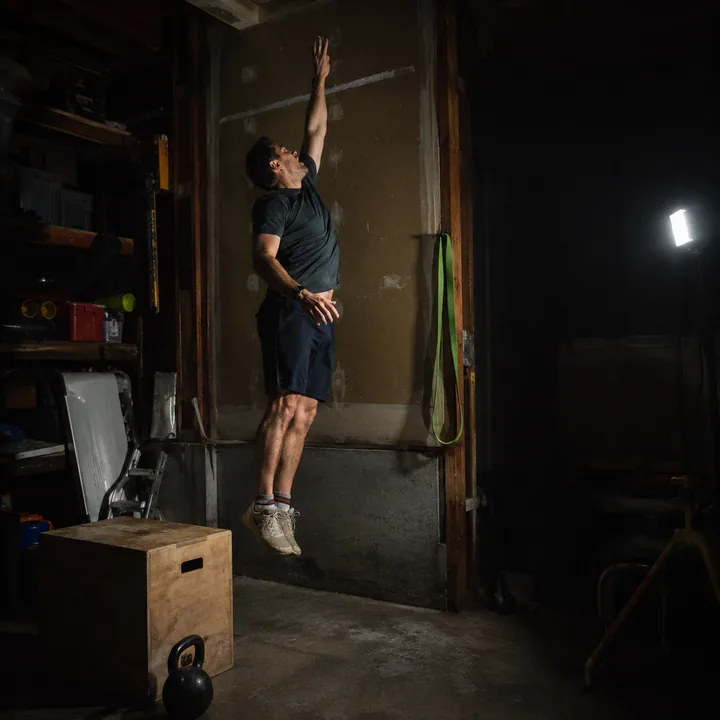
An athlete at the peak of a maximum vertical jump reaching for a chalk mark high on a wall

How the vertical jump test works

Your vertical jump is your standing reach subtracted from the highest point you can touch on a maximum jump. If you reach 90 inches flat-footed and touch 114 inches at the top of a jump, your vertical is 24 inches. That single number is how athletes, coaches, and combine scouts compare lower-body explosiveness across any body size.
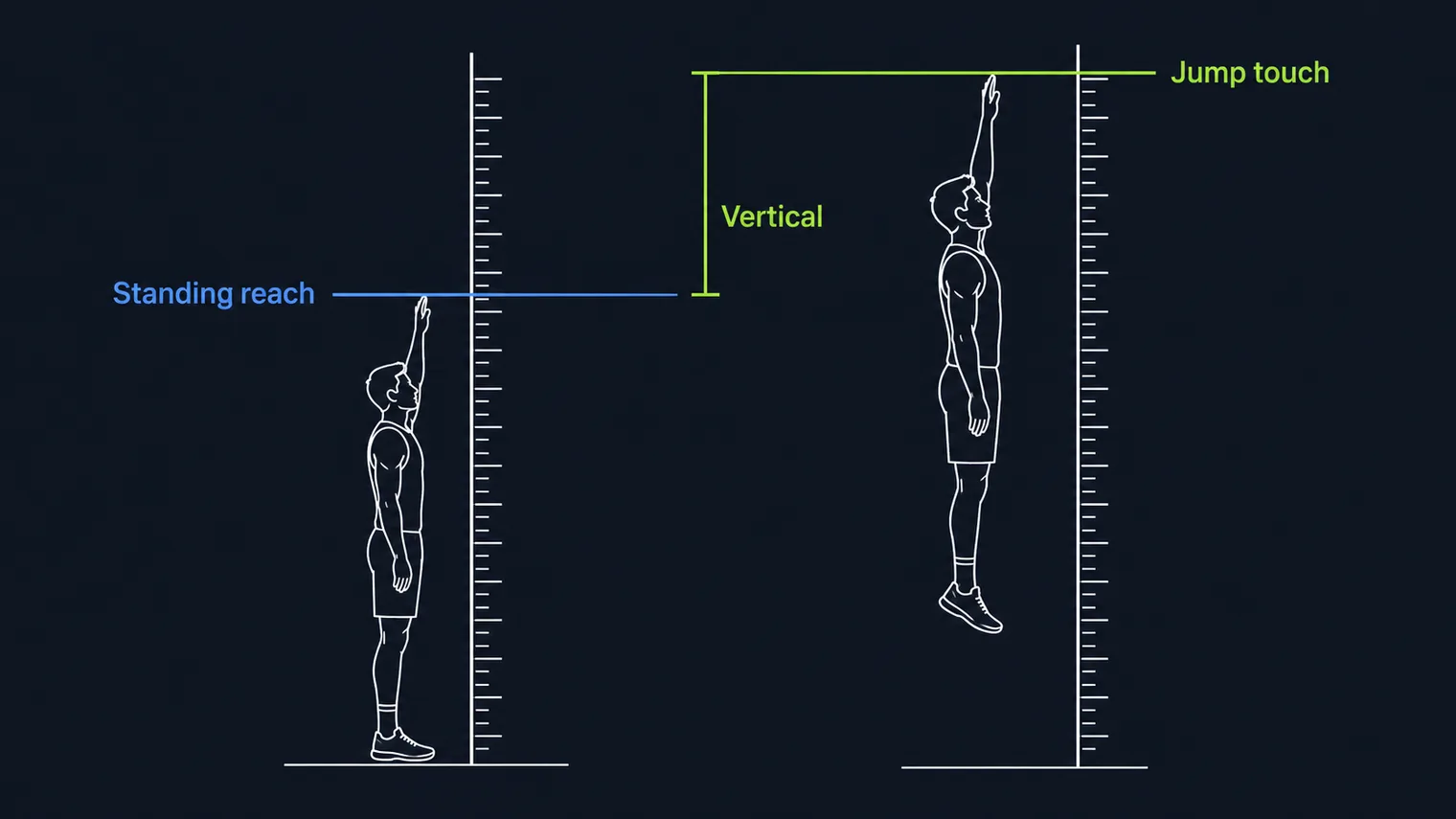
Diagram showing vertical jump equals jump-touch height minus standing reach

The reason the test subtracts standing reach is fairness. A 6'4" player and a 5'9" player can have the exact same vertical, even though the taller player touches a much higher point. By measuring only the difference, the test isolates the thing that training actually changes: how much force your legs and hips put into the ground. That is why the vertical jump is a standard drill at the NFL combine, in volleyball programs, and in nearly every basketball strength room.

Measuring it at home

Chalk-dusted fingertips marking touch height on a wall to measure a vertical jump

You do not need a Vertec or a jump mat. The cheapest accurate method is chalk on a wall:

  • Stand side-on to a wall, feet flat, and reach as high as you can. Mark that point. That is your standing reach.
  • Chalk your fingertips, take one or two steps if your sport allows an approach, jump as high as possible, and slap the wall at the peak.
  • Measure from the standing-reach mark up to the jump mark. That distance is your vertical.

Do three attempts with full rest between them and keep your best. Fatigue lowers your jump fast, so do not test at the end of a long session. For the full method, see our guide on how to measure your vertical jump at home.

What counts as a good vertical jump?

It depends on your age, sex, and sport. An 18-inch vertical is roughly average for an adult man and above average for an adult woman. For a high schooler chasing a dunk it is a starting point; for a college wide receiver it is below the bar. The tables below show typical ranges so you can place your own number in context. Use them as a guide, not a verdict on your potential.

Average vertical jump by age (males, inches)
Age groupTypical range
10–1211–14
13–1514–17
16–1816–20
19–2518–22
26–3516–20
36–4514–18
46+11–15

Vertical jump tends to peak in the late teens and early twenties, then declines gradually with age as fast-twitch muscle and tendon stiffness change. Adult women average roughly 12 to 16 inches. These are population averages, not ceilings, and consistent training can push you well past them. For the full breakdown, read average vertical jump by age.

Typical vertical jump by sport (inches)
SportTypical range
Basketball22–28
Volleyball19–26
Track & field20–28
Football (wide receiver)28–34
Soccer16–21
General fitness16–20

See how every sport compares, and what counts as elite in each, in average vertical jump by sport.

What vertical do you need to dunk on a 10ft rim?

The rim sits at 120 inches. To dunk cleanly you need your fingertips to clear the rim by a few inches so the ball goes down and not off the back iron, so most people aim for a touch point around 126 inches. Subtract your standing reach from that target and you have the vertical you need. Someone with a 7'6" (90-inch) standing reach needs about a 36-inch vertical for a clean two-hand dunk, while a longer-armed player at an 8'0" reach needs only about 30 inches. This is exactly why reach matters as much as raw spring, and why the test above asks for your reach instead of just your height. For the numbers at every height, see what vertical you need to dunk.

How fast can you add inches?

Honest numbers keep you from quitting. Most beginners who have never trained jumping add 2 to 4 inches in their first trained year with consistent plyometrics and lower-body strength work, and young or very untrained athletes sometimes see more. Intermediate athletes fight for 1 to 3 inches a year, and advanced jumpers for fractions of an inch. Progress slows because the easy adaptations come first. The fastest gains come from getting stronger in the squat and hinge, then layering in explosive jump work, not from jump training alone. Our full plan is in how to increase your vertical jump, and the exercises with sets and reps are in the vertical jump workout. Chasing a dunk specifically? Follow the honest dunk progression.

A teenage basketball player jumping to touch the backboard on an outdoor court at dusk
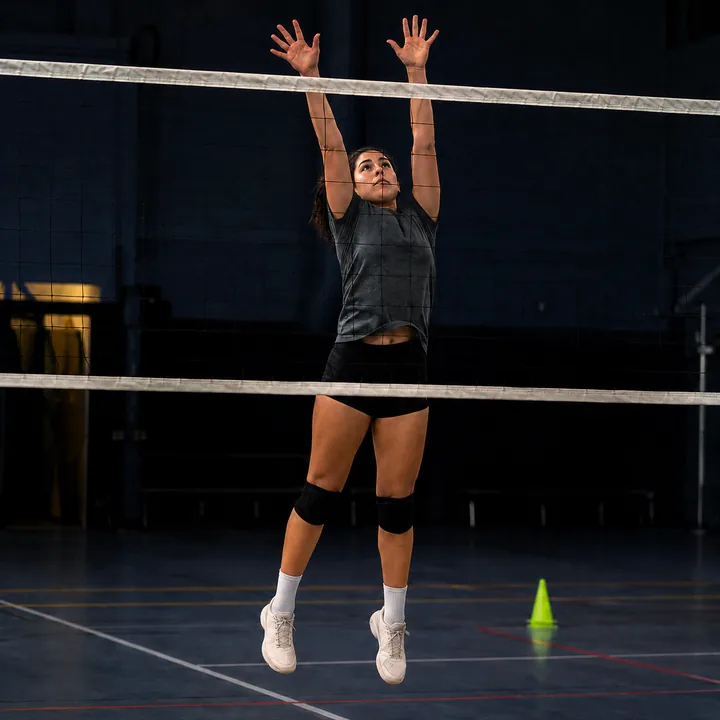
A volleyball player at the top of a block jump at the net
A person jumping to touch a chalk mark in a garage home gym

How do you stack up against the pros?

Some of the highest verticals ever recorded come from the NFL combine and the NBA draft combine, where the jump is measured on the spot. Others are the stuff of legend, reported for decades but never officially tested. We keep an honest list that labels which is which.

  • NFL combine record ~46 in
  • NBA draft combine record ~48 in
  • Elite (adult male) 28+ in
  • Average (adult male) 16–20 in
See the full vertical jump leaders list →

Deep dives: Michael Jordan's real vertical · Ja Morant's reported number

Gear to measure and train your vertical

A short, honest list of the tools that actually help. No gimmicks, and nothing you do not need.

As an Amazon Associate, we earn from qualifying purchases. This does not change the price you pay.

Measure your jump

You do not need to buy anything to measure your vertical. Rub a little gym chalk on your fingertips, mark the wall at your standing reach and again at the top of your jump, then read the gap with a tape measure you almost certainly already own. See the full step-by-step method →

Vertical jump testers

Want an exact number without the wall-and-chalk routine? Vertec-style swing-vane and wall-mounted testers read your touch height directly. They run from around $130 to well past $450, so this is really a coach, school, or team-budget buy rather than a home essential.

  • Exact touch height, no wall marks or chalk
  • Vertec-style swing-vane or wall-mounted options
  • Best for teams, schools, and coaches
See vertical jump testers on Amazon

Train your jump

Vertical jump trainer

The one piece of kit built specifically for this. A resistance harness loads your legs on every rep, so ordinary jumps build explosive power. Not magic, but a genuinely convenient way to add resistance to jump work at home.

  • Loads the jump itself, not just the muscles around it
  • Packs down and works in any room
  • The most vertical-specific tool on this list
See jump trainers on Amazon

Plyometric boxes

Box jumps and depth jumps build the explosive, reactive strength that adds inches. Start at a height you can land softly.

  • Builds the reactive strength that adds inches
  • Adjustable heights as you progress
  • Doubles for step-ups and box squats
See plyo boxes on Amazon

Resistance bands

Bands add load to squats and assist sprints and jumps. A cheap, packable way to build lower-body strength at home.

  • Add load to squats and jumps, no rack needed
  • Packable, so you can train anywhere
  • A cheap way to build lower-body strength
See bands on Amazon

Jump ropes

Rope work builds calf and ankle stiffness, the springy tissue that returns energy on every jump. Cheap and effective conditioning.

  • Builds springy calf and ankle stiffness
  • Low-impact conditioning that carries over
  • Cheap, and it fits in a bag
See jump ropes on Amazon

Common questions

How is vertical jump measured?

Subtract your standing reach (arm fully up, feet flat) from the highest point you touch on a maximum jump. The difference, in inches or centimeters, is your vertical jump.

What is a good vertical jump?

For adult men, 16 to 20 inches is average, 20 to 24 rates above average, and anything above 28 inches is excellent. For adult women, 12 to 16 inches is average and 24 inches and up is excellent. Good is relative to your age and sport, which is why the test rates your number against both.

Is a 30-inch vertical good?

Yes. A 30-inch vertical is well above the adult-male average of 16 to 20 inches and is solid for basketball or volleyball. It puts many players within reach of dunking, depending on standing reach.

What vertical do I need to dunk?

It depends on your standing reach. The rim is 120 inches and you want to touch about 126 inches to dunk cleanly. Subtract your reach from 126 to get the vertical you need. Most people with an average reach need somewhere between 28 and 36 inches.

Does vertical jump decrease with age?

Yes, gradually. It typically peaks in the late teens and twenties, then declines as fast-twitch muscle and tendon properties change. Strength training slows the decline significantly.

How can I improve my vertical jump?

Build lower-body strength first with squats and hinges, then add explosive plyometric work like depth jumps and bounding. Most beginners add 2 to 4 inches in their first trained year, and young or very untrained athletes sometimes see more.

How accurate is this vertical jump test?

The math is exact: your vertical is jump-touch height minus standing reach. Accuracy depends on how carefully you measure those two numbers. Use a wall and chalk, take your best of three attempts, and measure when fresh.

What is the average vertical jump for a 15-year-old?

A 15-year-old male typically jumps 14 to 17 inches, though trained young athletes often exceed that. Vertical jump rises quickly through the late teens as strength and coordination develop.

Can you dunk with a 32-inch vertical?

Only with a long reach. A clean dunk means touching about 126 inches, so a 32-inch vertical needs a standing reach of roughly 94 inches, about 7 feet 10. At a typical 7'6" (90-inch) reach, 32 inches gets you above the rim but about 4 inches short of a clean dunk. Enter your own reach in the test above for an exact answer.

Should I measure my vertical in inches or centimeters?

Either works. The test has an inches and centimeters toggle, so use whichever your training resources use. The rating is the same once converted.

How do I measure my standing reach?

Stand flat-footed against a wall with your stronger arm stretched straight up and your shoulder pressed high. Mark the highest point your fingertip touches, then measure from the floor to that mark. Do not rise onto your toes, since that inflates the number and throws off your vertical.

Is a 40-inch vertical possible?

Yes, but it is rare. A 40-inch vertical is elite territory reached mostly by top combine athletes and the most explosive pros, far beyond the adult-male average of 16 to 20 inches. Almost nobody trains their way there from an average start, so treat it as a ceiling for genetic outliers rather than a realistic goal.