The Vertical Jump Workout: Strength and Plyo Exercises to Jump Higher
A vertical jump workout has two layers: strength exercises (squats, hinges, split squats, calf raises) that build force, and plyo exercises (pogo hops, box jumps, broad jumps, depth jumps) that teach you to use it fast. Run the 2-day or 3-day plan below for 8 weeks, cap plyo work at 40–60 quality contacts per session, and retest your vertical at weeks 4 and 8.
Before you train: get a baseline
Measure your vertical first so you can prove the program works. Two minutes with a wall, or the reach-and-touch method, gives you a starting number. Without it, you are guessing for the next 8 weeks, and guessing is how people quit programs that were actually working.
This page is the exercise library and the weekly plan: what to do, how to do it, and how many sets and reps. If you want the reasoning behind the programming (why strength has to come first, what gains are realistic per year of training, how technique fits in), read the full guide to increasing your vertical jump. The short version you need before touching a barbell:
A jump has two engines. Force is how hard your legs and hips can push, and you build it with strength training. Rate of force is how fast you can deliver that push in the roughly quarter second your feet are loading the ground, and you build it with plyometrics. Strength training for vertical jump without plyos leaves power stuck in the weight room. Plyos without strength means converting a resource you never built. Every exercise below serves one of those two engines.
Tier 1: Strength exercises (the base)
Lift heavy enough that the last rep of each set is hard but clean. Beginners should spend 2–4 weeks learning each movement light before loading it. Rest 2–3 minutes between heavy sets; strength work is not conditioning.
Back squat (or goblet squat)
Form cues: bar on the upper back (or a dumbbell held at the chest for goblets), feet about shoulder width, sit down between your hips to at least parallel, drive up through the whole foot. Keep your torso braced; the fastest way to stall a squat is turning it into a good-morning.
Sets x reps: 3–5 x 3–6 once form is solid. Progression: add small amounts of weight when all sets move well. Regression: goblet squat 3 x 8–10, then box squats to a bench if depth is hard.
Romanian deadlift (the hinge)
Form cues: soft knees, push your hips straight back until you feel a hard hamstring stretch, bar or dumbbells sliding down your thighs, flat back the whole way, then drive the hips forward to stand. The hinge is the pattern that finishes a jump, so treat the lockout as the point of the lift.
Sets x reps: 3 x 6–8. Progression: load, then tempo (3-second lowering). Regression: dumbbell RDL, or a hip hinge drill with a dowel along your spine.
Bulgarian split squat
Form cues: back foot on a bench, front shin roughly vertical, drop the back knee straight down, drive through the front foot. Expect the first sessions to be a balance fight; that is part of what it trains. Single-leg strength carries directly to one-foot jumping and fixes the left-right imbalances a barbell hides.
Sets x reps: 3 x 6–8 per leg. Progression: hold dumbbells. Regression: split squat with both feet on the floor, or rear-foot-supported with a hand on a rail.
Calf raises, straight knee and bent knee
Form cues: full range on every rep, pause one second at the top and at the bottom stretch. Do them standing with straight knees (targets the gastrocnemius, the jumping calf muscle) and seated or bent-knee (targets the soleus, the tendon-protecting workhorse underneath).
Sets x reps: 3 x 10–12 straight knee, 3 x 12–15 bent knee. Progression: single leg, then add load. Strong calves will not add many inches by themselves, but they build the ankle stiffness plyos depend on and armor the Achilles for everything else on this page.
Trap-bar deadlift (optional)
If your gym has a trap bar, it is arguably the friendliest heavy pull for athletes: the load sits at your sides, the back stays more upright, and the movement looks a lot like a loaded jump. Sets x reps: 3–4 x 3–5, and it can replace back squats in a pinch. Skip it entirely if you do not have the bar; squats plus RDLs cover the same ground.
Tier 2: Plyo exercises for vertical jump (the converter)
Plyometric work for vertical jump follows different rules than lifting, and it is the best-proven jump builder there is: a meta-analysis of plyometric training studies found it reliably raises vertical jump height across training levels. Every rep is max intent, every landing should be quiet, and you stop while you still feel springy. Do plyos first in a session, when you are fresh. Count your ground contacts: for beginners, roughly 40–60 quality contacts per session is plenty (a set of 5 broad jumps is 5 contacts).
Pogo hops (ankle bounces)
Form cues: legs nearly straight, bounce off the balls of your feet using only the ankles, minimal knee bend, imagine the ground is hot. This is your entry-level plyometric and your warm-up staple; it teaches the stiff, springy ankle every other jump borrows from.
Sets x reps: 3 x 15–20. Progression: for height, then single-leg pogos. Regression: gentle two-foot bouncing in place, or jump rope.
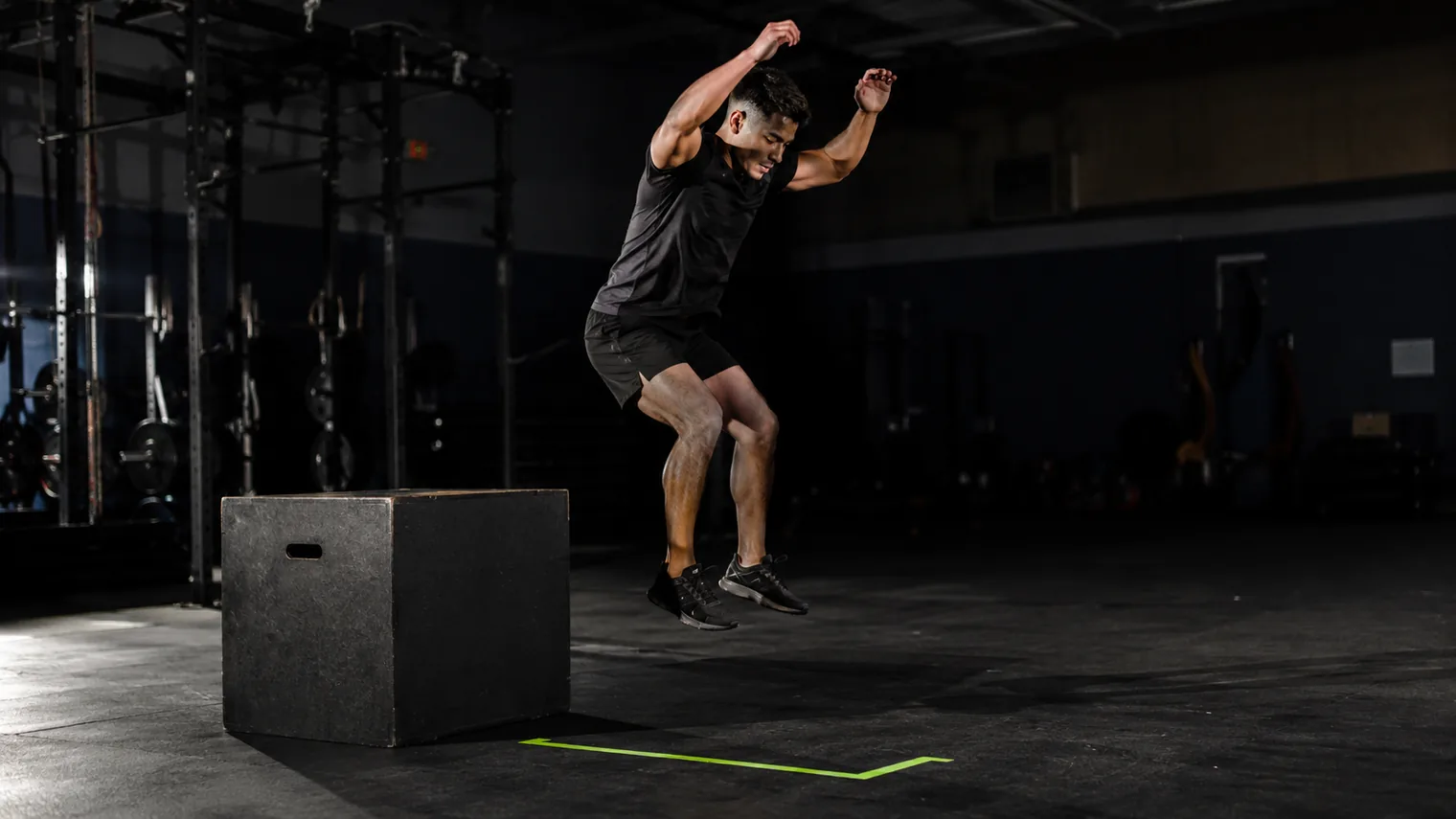
Box jumps
Form cues: big arm swing, explode up, land soft on top with your whole foot on the box and hips above your knees. Then step down, never jump down; the step-down is what keeps box jumps easy on your joints. Use a box height that lets you land tall, not one you barely clear in a deep tuck.
Sets x reps: 3–4 x 3–5. Progression: modest height increases only while landings stay quiet. Regression: jump to a low step, or vertical jumps to a target on a wall.
Broad jumps
Form cues: swing the arms back, load the hips, and jump for maximum distance, sticking the landing in a stable quarter squat. Reset completely between reps. Broad jumps train the violent hip extension that a vertical shares, with the bonus that the tape measure keeps you honest.
Sets x reps: 3–4 x 3. Progression: chase distance, then do them as repeated jumps (advanced). Regression: squat jumps in place with a full reset.
Depth jumps (advanced only)
The depth jump is the highest-intensity plyometric in common use: step off a box, land on both feet, and explode straight up the instant you touch down. The fall pre-loads your muscles and tendons far beyond what a normal countermovement can, which is exactly why it works and exactly why it hurts people who are not ready.
The honest caveat: a common coaching standard is squatting around 1.5 times your body weight before programming real depth jumps. Below that, the landing forces exceed what your tendons are prepared for, and the exercise trains injury rather than power. Earn it first.
Form cues: step off (do not jump off) a 12-inch box to start, 24–30 inches as a hard ceiling even for advanced jumpers. The intent on the ground is everything: minimal contact time, like the floor is a trampoline you are trying not to sink into. If you sink into a slow squat before leaving the ground, the box is too high.
Sets x reps: 2–3 x 3–5, once or twice a week at most, never on tired legs. Regression: box jumps and broad jumps until you meet the strength standard.
Bounding
Form cues: exaggerated running strides, driving off one leg and floating as far as possible to land on the other, arms working in big cycles. Bounding builds single-leg elastic power and rhythm, the qualities a running one-foot jump lives on.
Sets x reps: 3 x 20–30 meters. Progression: distance per stride. Regression: skips for height, which teach the same rhythm at lower force.
Single-leg hops
Form cues: small, repeated hops on one leg, landing on the ball of the foot with a stiff ankle and a level pelvis. Start in place, then hop for short distances. These bulletproof the ankle and knee for one-foot takeoffs.
Sets x reps: 2–3 x 5 per leg. Progression: distance, then low hurdles. Regression: two-foot pogo hops until one leg feels stable.
Tier 3: Sport-specific jumps
These convert gym power into the jump your sport actually uses. Add them in the second half of the program, in small doses, on fresh legs.
Approach jumps
Practice the exact footwork you jump with in games: a basketball one-two gather off the dribble, or a volleyball three-step or four-step approach into a two-foot plant. Sets x reps: 4–6 x 2–3 max-effort jumps at a rim, net, or wall target. The penultimate step (long and low, gathering the hips) is where most untrained jumpers leak height, so treat these as technique work at full speed.
Band-resisted jumps
Stand on a light resistance band, hold the other end at your shoulders or hips, and perform countermovement jumps against the band's pull. The band adds resistance through the exact jumping pattern without loading your spine. Sets x reps: 3 x 5 with a light band; the jump should still feel fast, not grinding.
Weighted jump squats
Jump squats with light dumbbells or an empty bar add load to the jump itself. Keep it honest: roughly 10–20% of body weight at most, and the moment your jumps get visibly slower or your landings get heavy, the load is too much. Sets x reps: 3 x 5, technique first, and skip these entirely if depth jumps and heavy squats already have you near your weekly tolerance.
The weekly plan
Both versions below combine the tiers into workouts to increase your vertical, with plyos first while you are fresh and strength after. Pick the 2-day plan if you also practice or play games most days; pick the 3-day plan if jumping is your main training focus. Never run jump sessions on back-to-back days.
2-day plan
| Day | Exercise | Sets x reps | Rest |
|---|---|---|---|
| Day A | Pogo hops | 3 x 15 | 60 s |
| Day A | Box jumps | 4 x 3 | 90 s |
| Day A | Back squat or goblet squat | 4 x 5 | 2–3 min |
| Day A | Romanian deadlift | 3 x 8 | 2 min |
| Day A | Calf raises (straight knee) | 3 x 10 | 60 s |
| Day B | Pogo hops | 3 x 15 | 60 s |
| Day B | Broad jumps | 4 x 3 | 90 s |
| Day B | Bulgarian split squat | 3 x 8 per leg | 2 min |
| Day B | Single-leg hops | 2 x 5 per leg | 90 s |
| Day B | Calf raises (bent knee) | 3 x 12 | 60 s |
Schedule Day A and Day B with at least two days between them, for example Monday and Thursday.
3-day plan
| Day | Exercise | Sets x reps | Rest |
|---|---|---|---|
| Day 1 (strength focus) | Box jumps | 3 x 3 | 90 s |
| Day 1 (strength focus) | Back squat | 4 x 5 | 2–3 min |
| Day 1 (strength focus) | Romanian deadlift | 3 x 8 | 2 min |
| Day 1 (strength focus) | Calf raises (straight knee) | 3 x 10 | 60 s |
| Day 2 (plyo focus) | Pogo hops | 3 x 15 | 60 s |
| Day 2 (plyo focus) | Broad jumps | 4 x 3 | 90 s |
| Day 2 (plyo focus) | Bounding | 3 x 20 m | 2 min |
| Day 2 (plyo focus) | Single-leg hops | 2 x 5 per leg | 90 s |
| Day 3 (mixed + sport) | Approach jumps | 5 x 2 | 90 s |
| Day 3 (mixed + sport) | Band-resisted jumps | 3 x 5 | 90 s |
| Day 3 (mixed + sport) | Bulgarian split squat | 3 x 8 per leg | 2 min |
| Day 3 (mixed + sport) | Calf raises (bent knee) | 3 x 12 | 60 s |
Space the three days out, for example Monday, Wednesday, and Friday. Depth jumps, once you qualify for them, replace box jumps on Day 1 at 2–3 x 3.
The 8-week arc
- Weeks 1–2 (base): learn every movement at easy loads and low box heights. Cut the listed jump volume by a third. Boring on purpose; this is where tendons start adapting.
- Weeks 3–6 (build): run the plan as written. Add weight to the lifts when all sets are clean, and let the jumps get more aggressive as landings stay quiet.
- Weeks 7–8 (peak): keep the intensity, trim the volume by about a third again, and stay sharp. Retest at the end of week 8 on fresh legs.
Retest at weeks 4 and 8, the same way every time. Use the vertical jump test with the same shoes, same surface, and same warm-up so the number reflects training, not conditions. If you test with the wall method, the guide to measuring your vertical at home covers how to keep it repeatable. Expect the week 4 number to move a little or not at all; the week 8 number is the one the program is aimed at. (Outside a structured program like this one, every 6–8 weeks is often enough.)
Recovery and dosage
Jump training rewards the minimum effective dose. Muscles recover in a day or two; the tendons that plyos hammer (patellar and Achilles) adapt more slowly, and they do not announce overload until they already ache. That is why the caps in this program are real limits, not suggestions:
- 40–60 quality ground contacts per plyo session for beginners. Experienced jumpers can handle more, but nobody needs 200.
- At least 48 hours between plyo sessions. The adaptation happens between workouts, not during them.
- Stop while you are still springy. The rep where you feel flat is the rep after you should have stopped. Tired jumping does not build power; it rehearses slow mechanics and loads sore tendons.
- Sleep is a training variable. Aim for 8 hours. Power output, coordination, and tendon recovery all degrade on short sleep, and no supplement buys it back.
More is not better here. A jumper who does 50 crisp contacts twice a week for 8 weeks beats one who does 150 sloppy contacts four times a week and spends week 6 icing a knee.
Common mistakes
- All plyos, no strength base. Plyometrics convert strength into height. If your squat is weak, there is little to convert, and the fastest fix for your vertical is two months of getting stronger.
- Ego box jumps. A 40-inch box jump is mostly a 40-inch knee tuck. Your hips do not rise higher just because the box does. Pick heights you land tall on, and measure progress at the rim, not the box.
- Testing fatigued. A vertical measured the day after squats is a fatigue report, not a progress report. Retest on fresh legs, after your normal warm-up, at the same time of day.
- Loading sloppy mechanics. Adding weight to a jump squat, or height to a depth jump, before the unloaded version is clean just makes the flaws stronger. Load is the last progression, never the first.
Once your number starts climbing, put it in context: see how it stacks up against the average vertical jump for your age, and if the rim is the goal, work out exactly what vertical you need to dunk from your standing reach so the program has a finish line.