Ja Morant's Vertical Jump: The Reported 44, the Unverified 50, and What the Film Shows
Ja Morant's vertical jump is usually listed at 44 inches (112 cm), a number reported from a 2019 pre-draft team workout. He never tested at the NBA Draft Combine, so no official measurement exists, and the viral 50-inch claim has never been verified. His game film supports an elite 40-plus inch running leap.
Where the 44 inches comes from
Ja Morant did not go through athletic testing at the 2019 NBA Draft Combine. Top prospects with a locked-in draft slot routinely skip testing, since a surprising number can only hurt their stock, and Morant was widely projected to go second overall. Whatever the reasoning, the outcome is simple: the league has no official vertical jump on file for him.
The famous 44-inch figure surfaced instead in reports out of a pre-draft team workout in 2019. Numbers from private workouts arrive secondhand. There is no published testing protocol, no footage of the measurement, and no way to confirm whether it was a standing vertical or a max approach jump. That does not make the number false; plenty of workout reports turn out to be accurate. It makes the number unverifiable, which is a different thing. Our vertical jump leaders database lists Morant at 44 inches with a "reported" label for exactly that reason.
The 50-inch claim, and why it does not hold up
Once Morant started posterizing NBA centers, a bigger number began circulating: a 50-inch vertical, usually traced back to offseason training hype and clipped social posts. It spread because it feels believable when you watch him play. It should still be treated as folklore.
Here is the problem with 50. The highest vertical ever measured at the NBA Draft Combine is Keon Johnson's 48 inches, set in 2021 under controlled conditions with a Vertec and officials watching. A 50-inch jump would clear the best verified leap in combine history by two full inches. A claim that size needs a tape, a camera, and a protocol behind it, and the Morant claim has none of the three. No documented test of a 50-inch Morant vertical has ever surfaced.
So the honest ledger reads: 44 is reported, 50 is unverified, and the only thing we can measure directly is what he does in games.
What his game film actually supports
Morant is one of the best one-foot leapers of his generation, and the film says so without needing a Vertec. His signature in-game moments, the full-extension dunks over rim protectors and the chase-down blocks pinned high on the backboard, are the kind of plays that require getting a hand far above the 10-foot rim at speed, while timing a moving target.
Watching those plays, an elite running leap of 40-plus inches is a reasonable read. Be clear about what that is, though: an inference from film, not a measurement. We can bound it with arithmetic (more on that below), but nobody has published a verified number.
Running one-foot leap vs the tested vertical
The distinction matters because "vertical jump" covers two different skills. The combine's standing vertical is a no-step, two-foot jump measured from a standstill. The max vertical adds a short approach. A true in-game running jump, the kind Morant lives on, lets a player convert sprint speed into lift through a long, low penultimate step, and explosive one-foot jumpers typically gain several inches off a run compared to standing still. So a player can own a genuinely elite approach leap while his standing number sits meaningfully lower. Whatever Morant's 44 was measuring, his most spectacular flights almost certainly come off one foot with a runway.
Morant vs measured combine numbers
The cleanest way to place Morant is next to players who did stand under the Vertec. Every number below except his is an official measurement.
| Player | Max vertical | Year and setting | Status |
|---|---|---|---|
| Keon Johnson | 48.0 in | 2021 NBA Combine (record) | Measured |
| Hamidou Diallo | 44.5 in | 2017 NBA Combine | Measured |
| Ja Morant | 44.0 in | 2019 pre-draft team workout | Reported |
| Mac McClung | 43.5 in | 2021 pre-draft measurement | Measured |
| Zach LaVine | 41.5 in | 2014 NBA Combine | Measured |
| Derrick Rose | 40.0 in | 2008 NBA Combine | Measured |
Read the table with the labels in mind. If the workout report was accurate, Morant sits just under Diallo and above LaVine and Rose, elite company by any standard. But "if accurate" is doing real work in that sentence, and it is the difference between his row and every other row. Michael Jordan's celebrated leap lives in the same reported-not-measured category, which we cover in Michael Jordan's vertical jump.
The reach math: what his dunks imply at 6'3"
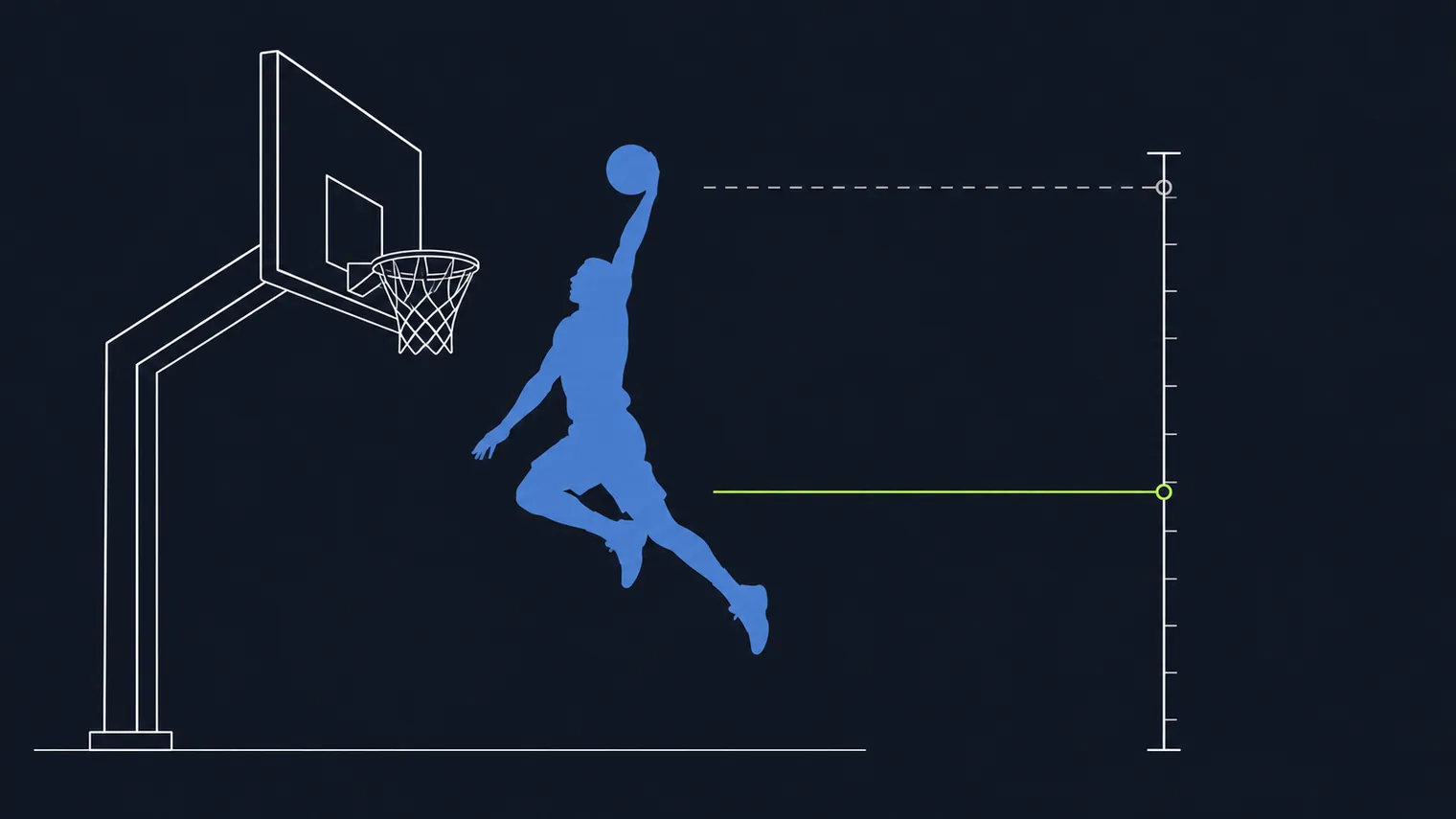
Morant is listed at 6'3" (75 inches), short by NBA rim-attacking standards, which is exactly why his dunks look the way they do. His standing reach was never officially measured either, but a typical standing reach for a 6'3" guard runs about 8'2" to 8'4" (98 to 100 inches). The rim sits at 120 inches. From there the arithmetic is straightforward, as long as we present it as the estimate it is:
- Touching the rim: 120 minus a 98–100 inch reach means roughly a 20–22 inch jump.
- A clean dunk (hand and ball comfortably above the cylinder, call it 6 inches over): roughly 26–28 inches.
- A power dunk with the wrist and lower forearm over the rim: roughly 30–34 inches.
- His loudest finishes, where the ball is cocked well above rim level before it comes down: roughly 38–42 inches or more.
Because the reach is assumed rather than measured, treat the output as a band, not a decimal. But the band lands right where the film points: an in-game, ball-in-hand running leap somewhere around 40 inches. A rested, max-effort test with no ball and no defender usually beats what a player shows mid-game, which is why a reported 44 is entirely plausible even though it remains unproven. If you want to run this math on your own body, our dunk calculator guide walks through it step by step.
What a normal athlete can take from a one-foot leaper
You will not train your way to Morant's runway, but his jump style is the trainable one. One-foot leaping rewards sprint speed, a long and low penultimate step, and stiff, springy ankles, all of which respond to focused work: bounds, pogo hops, calf and ankle strength, and lots of full-speed approach practice. For a structured plan, start with our vertical jump workout, and if the rim is the goal, how to dunk covers the progression from first rim grab to first slam.
Keep the baseline honest, too. The average untrained adult male jumps about 16 to 20 inches from a standstill, and 28-plus is elite. Nobody needs a 44 to play above the rim on a 9-foot hoop or to win the first step in a pickup game. Measure where you are with the vertical jump test, train for eight weeks, and re-test.