Michael Jordan's Vertical Jump: The Honest Number Behind the 48-Inch Legend
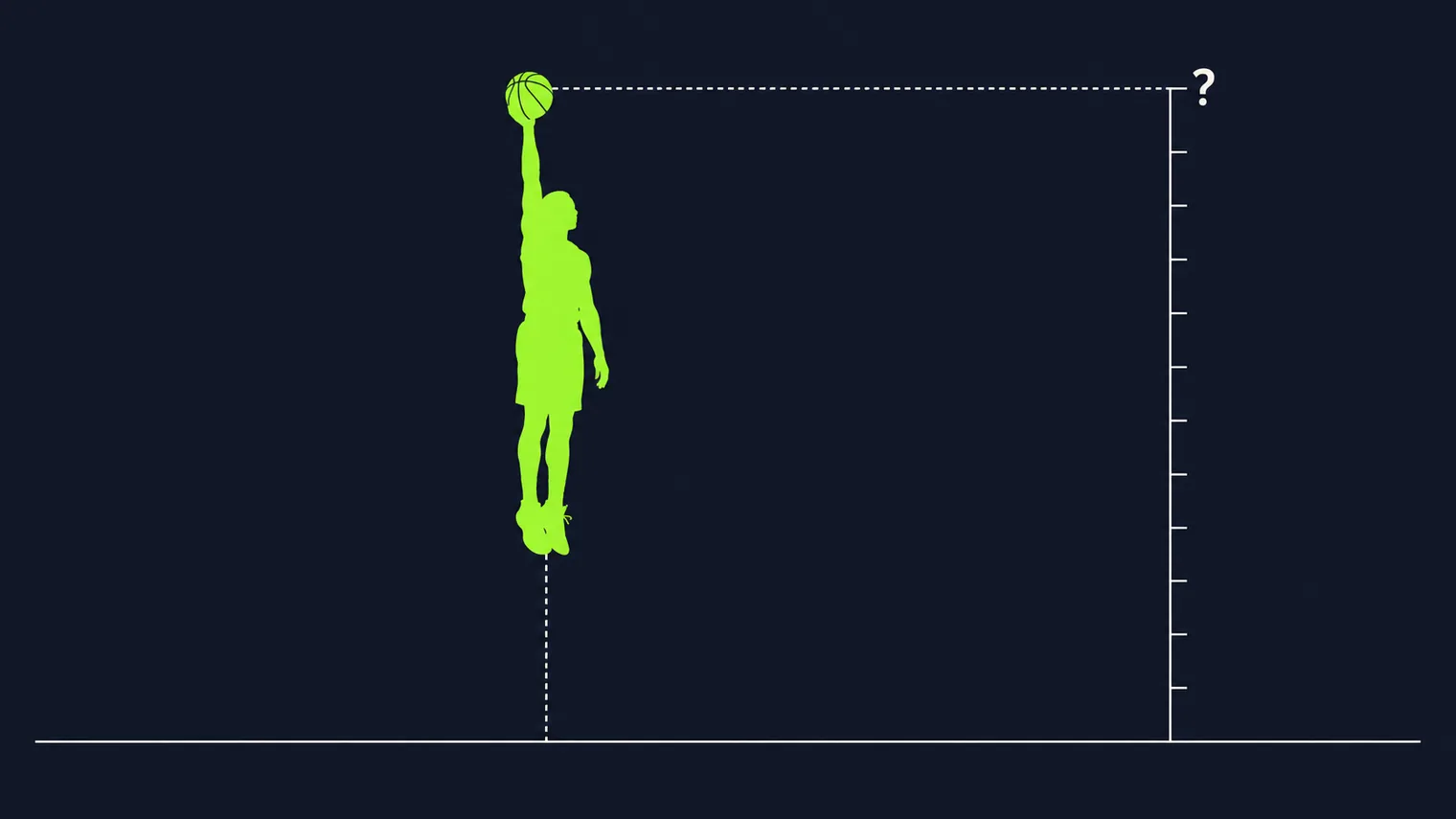
Michael Jordan's vertical jump was never officially measured, and Jordan said so himself. The famous 48-inch figure is 1980s lore, not a test result. Film analysis and hang-time physics put his best running leap at roughly 42–46 inches, and our vertical jump leaders list carries him at 46 inches labeled reported, an estimate, not a measurement.
The short answer
Ask the internet what Michael Jordan's vertical was and you will get "48 inches" back with total confidence. That number has been repeated so many times, in so many listicles, that it feels like a fact. It is not. There is no test sheet, no combine result, no team record behind it. Jordan was never officially measured, and he said as much on camera.
The honest version is less tidy but more interesting: the best evidence supports a running maximum somewhere around 42 to 46 inches, which would still make Jordan one of the greatest leapers basketball has ever seen. The gap between "one of the greatest ever, around 42–46" and "a clean 48" is exactly the gap between what the film supports and what the legend added on top.
Where the 48-inch legend came from
The 48 was born in the 1980s, when Air Jordan marketing and highlight reels turned Jordan's leaping into a brand. "Hang time" became his signature word, and a huge round number fit the story better than a careful estimate ever could. Somewhere along the way, 48 inches got attached to his name, without anyone citing a test, a date, or a device.
Here is the detail that should have killed the myth decades ago: Jordan himself said his vertical was never measured. He said it in the 1980s, and he said it again in a 1993 interview with Larry King. The man at the center of the claim told everyone, twice, that no measurement existed.
The timeline backs him up. The NBA did not begin vertical jump testing at its pre-draft combine until 2000, well after Jordan's prime. There was no standardized league measurement for him to take when it would have mattered. So every "official 48-inch vertical" claim fails on the calendar alone: the test it implies did not exist yet.
None of that stopped the number. Listicles copied it from each other for decades, each repetition making it look more official, until "Jordan: 48 inches" became one of the most confidently stated unmeasured numbers in sports.
What hang-time physics actually supports
You do not need Jordan's cooperation to sanity-check the legend, because gravity does the bookkeeping for free. Jump height fixes flight time exactly: a jumper who raises their center of mass 48 inches spends almost exactly one full second in the air. A 46-inch jump gives about 0.98 seconds, a 42-inch jump about 0.93 seconds.
Two things follow from that math. First, the differences are tiny. The gap between a 42-inch leap and a 48-inch leap is well under a tenth of a second of air time, which is why nobody's eyes can tell them apart from the stands, and why "he was up there forever" testimony inflates so easily. Second, the tape is checkable. Jordan's most famous dunks are on film, and frame-by-frame timing of those flights is consistent with a jumper in the low-to-mid 40s at his best, not comfortably beyond it.
That is where the honest estimate comes from: hang-time analysis of documented dunks supports roughly 42 to 46 inches on his best running takeoffs. The top of that range is extraordinary. It just is not 48, and no measurement says otherwise.
What about the free-throw-line dunks?
Jordan's free-throw-line dunks in the 1987 and 1988 dunk contests are the exhibit most people reach for, and they are genuinely elite athletic feats. But they prove a specific skill: converting a full sprint into height, carrying enormous horizontal speed through a one-foot takeoff. Covering fifteen feet of floor while getting up is spectacular, and it is not the same thing as a measured reach-vertical. A dunk from the line tells you Jordan was a phenomenal athlete in motion; it does not tell you he tested at 48 inches, and treating one as proof of the other is how the myth keeps getting recycled.
Jordan vs. officially measured verticals
The cleanest way to put the legend in context is to line the estimate up against jumps that actually were measured, on standardized equipment, in front of officials. This is the standard our leaders list is built on.
| Athlete | Vertical | Status | Year |
|---|---|---|---|
| Keon Johnson | 48.0 in | Measured (NBA Combine record) | 2021 |
| Michael Jordan | ~46 in | Reported (estimate, never tested) | – |
| Gerald Sensabaugh | 46.0 in | Measured (NFL Combine record) | 2005 |
| Kenny Gregory | 45.5 in | Measured (NBA pre-draft) | 2001 |
| Zach LaVine | 41.5 in | Measured (NBA Combine) | 2014 |
Read that table carefully and the 48-inch legend gets even harder to defend. Keon Johnson's 48.0 inches in 2021 is the only officially measured 48 in NBA Combine history, and it stands as the record. Gerald Sensabaugh's 46.0 inches has been the NFL Combine record since 2005. If a verified 48 is a once-in-decades event among thousands of tested elite athletes, claiming Jordan casually owned that number without ever being tested is a big ask.
Zach LaVine is the most useful comparison for modern fans. His 41.5 inches at the 2014 combine is one of the best verified jumps the NBA has on record, and watching LaVine move tells you what a proven low-40s vertical looks like. Jordan at his best was likely in that neighborhood or a few inches above it. That is the realistic picture: Jordan among the greatest measured leapers ever, not floating in a category physics never signed off on.
Why measured vs. reported matters
This site exists to measure jumps, so the distinction is not pedantic to us; it is the whole product. A measured vertical comes from a controlled test: a fixed protocol, a standardized device, a recorded result. A reported number is everything else: estimates, recollections, marketing copy, and numbers passed between articles until they harden into "fact."
On our vertical jump leaders list, every entry carries one of those two labels. Jordan appears at 46 inches, the top of the credible estimated range, and he is labeled reported, because that is what the number is. Keon Johnson's 48.0 sits above him labeled measured, because that jump happened on a device, on a date, with witnesses. Mixing the two categories without labels is how the internet ended up believing a number nobody ever recorded.
The same discipline applies to your own jumping. Guessing off a rim touch inflates numbers the same way lore inflated Jordan's. If you want a real baseline, measure your vertical the same way combines do: standing reach subtracted from jump-touch height, tested fresh, recorded honestly.
What you can actually take from MJ
Strip the myth away and Jordan still teaches real lessons for anyone trying to jump higher. He was a one-foot leaper who converted speed into height better than almost anyone on film, which is a trainable skill: approach rhythm, a long penultimate step, and a stiff, fast takeoff. If dunking is the goal, start by finding your actual target with what vertical you need to dunk, then work through the approach mechanics in our how-to-dunk guide.
For the engine itself, a structured vertical jump workout that pairs strength work with low-volume plyometrics moves the number more reliably than any amount of highlight study. For reference, the average adult male vertical is around 16–20 inches, and 28 inches or more is elite territory; even the conservative end of Jordan's estimated range is more than double a typical jump. Test first, train the layers, re-test, and keep your own ledger honest: every number you write down should be measured, not reported.
Frequently asked
What was Michael Jordan's actual vertical jump?
Nobody knows the exact number, because it was never officially measured. Film analysis and hang-time physics put his best running leap at roughly 42 to 46 inches. Our leaders list carries him at 46 inches, labeled reported, meaning it is an estimate rather than a test result.
Was Michael Jordan's vertical ever officially measured?
No. Jordan himself said his vertical was never measured, first in the 1980s and again in a 1993 Larry King interview. The NBA did not begin combine vertical testing until 2000, after his prime, so no official number can exist.
Who has a higher measured vertical than Jordan's estimate?
Keon Johnson jumped a measured 48.0 inches at the 2021 NBA Combine, above the top of Jordan's estimated range. Gerald Sensabaugh's 46.0 inches at the 2005 NFL Combine matches it, and Kenny Gregory's 45.5 inches in 2001 sits just inside it. All three numbers were measured under controlled conditions; Jordan's 46 is an estimate.
What was Michael Jordan's hang time?
Gravity fixes hang time to jump height. A 46-inch vertical produces just under one second of total flight, and a 42-inch vertical about 0.93 seconds. Jordan's best documented leaps put him near, but not past, the one-second mark. The famous claim that he floated longer than physics allows is part of the myth.
Could Michael Jordan really dunk from the free-throw line?
Yes. His free-throw-line dunks in the 1987 and 1988 dunk contests are on film. They prove an elite ability to convert sprint speed into height, but a takeoff that covers that much horizontal distance is a different skill from a standing reach-vertical test, and it does not equal a measured 48-inch vertical.
How does Michael Jordan's vertical compare to Zach LaVine's?
Zach LaVine measured 41.5 inches at the 2014 NBA Combine, one of the best verified jumps in league history. Jordan's estimated 42 to 46 inches is probably a little higher, but LaVine's number is measured and Jordan's is not, which is exactly why the two should be labeled differently.
Why do so many sites say Jordan had a 48-inch vertical?
The 48 traces back to 1980s marketing and hang-time lore, not to a test. Listicles have copied the number from each other for decades, and repetition made it feel official. No measurement has ever backed it up, and Jordan himself said he was never tested.
What is the highest vertical ever officially measured at a combine?
Keon Johnson holds the NBA Combine record at 48.0 inches, set in 2021. At the NFL Combine, Gerald Sensabaugh's 46.0 inches from 2005 still stands as the record. Both jumps were measured on standardized equipment in front of officials.
How high could Michael Jordan jump?
On his best running takeoffs, the film supports a leap of roughly 42 to 46 inches, which is elite by any standard. That is a running jump into a dunk, not a standing test. The often-quoted 48 inches was never measured, so treat it as the ceiling of the legend, not a documented number.
Did Michael Jordan have a 48-inch vertical?
There is no test result behind the 48-inch figure. It comes from 1980s marketing and repetition, not a device or a date, and Jordan said his vertical was never measured. A verified 48 is once-in-decades rare even among tested combine athletes, so crediting him with it untested is a stretch. Our list carries him at 46 inches, labeled reported.
Who has a higher vertical than Michael Jordan?
Measured against Jordan's estimated 46, Keon Johnson's 48.0 inches at the 2021 NBA Combine is higher and verified. Christopher Spell's Guinness standing jump of about 67 inches is higher still, though it is a platform jump rather than a reach-vertical. The honest comparison is that these are measured numbers, while Jordan's is an estimate.
How does Michael Jordan's vertical compare to Ja Morant's?
Neither number is official, so any ranking is guesswork. Jordan's celebrated leap predates combine testing and lands at a reported 46 inches; Morant's 44 comes from a 2019 pre-draft team workout, also reported. Both are in the same honest category: legendary, plausible, and never measured under standardized conditions.
Keep going
Get your own measured number
Enter your standing reach and jump-touch height to get your vertical in inches, the same reach-vertical method the combines use. Measured beats reported, even for your own numbers.
Test my vertical